
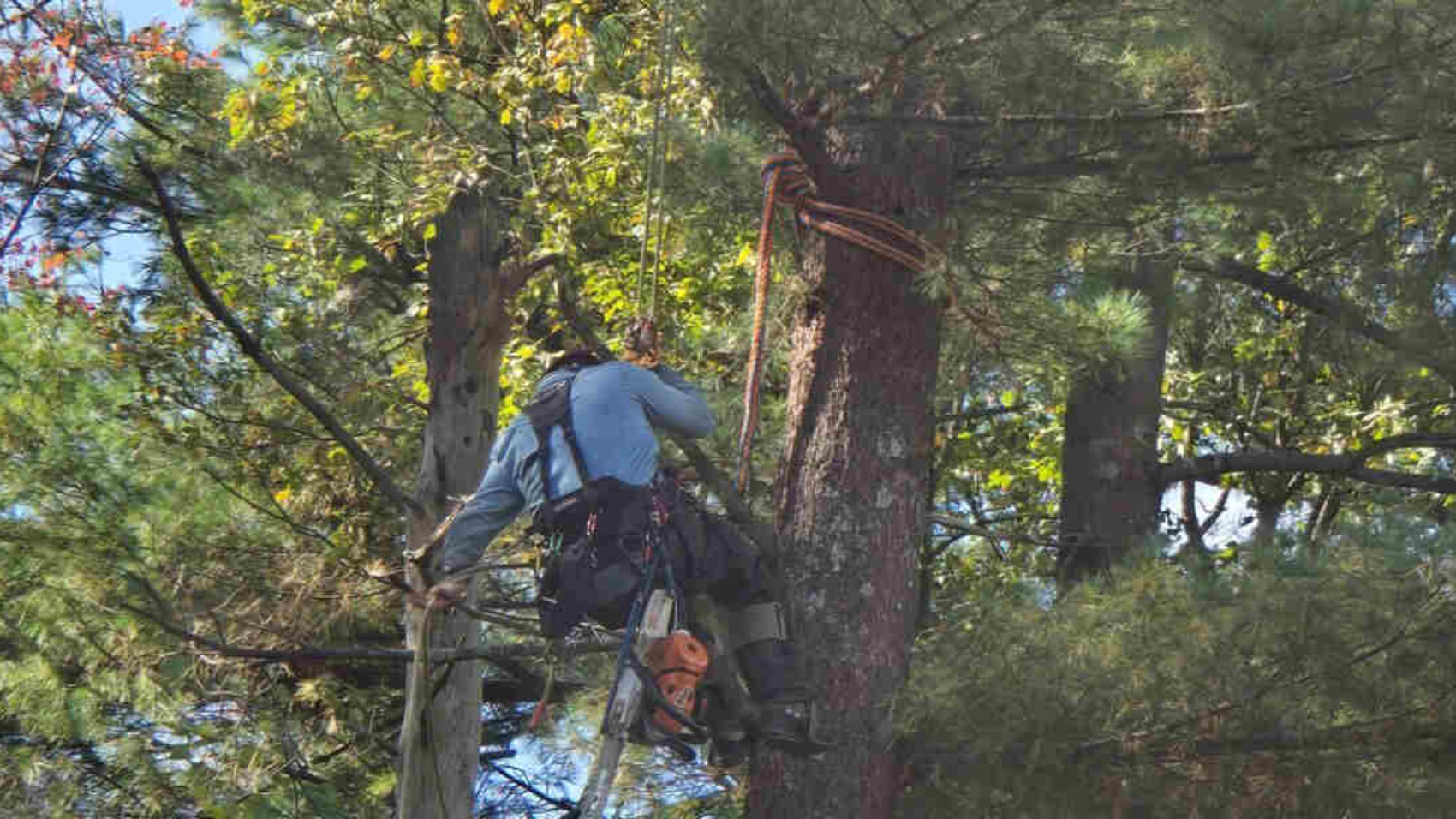
You can think of tree cabling and bracing as structural reinforcement, allowing weak trees to stand tall without the threat of falling over. If your trees lean too much or seem to have weak limbs, methods like cabling and bracing go a long way.
Brooke Tree Service offers tree services in Sherborn, MA. Keep reading as the team shares how tree cabling and bracing can help your trees so that you can know when to call us.
Storm Damage and Cracks
People often consider support systems for trees when they notice growth defects, but they help damaged trees, too. For example, if hail or heavy winds cause a limb to crack, limb support will keep the tree intact as it heals.
Arborists often use a rod and cable for damaged limbs. The rod will hold it in place. The cable will allow it to move freely within a safe range so that it doesn’t snap off.
V-Shaped Trunks
Twin trunks, sometimes called V-shaped trunks, are a common reason to implement tree cabling and bracing. Trees are stronger when they have one single trunk. Two trunks create the risk of cracking and snapping off in a severe storm or heavy winds.
If a V-shaped tree is near a home, it could be an insurance nightmare. Dynamic cabling methods would be ideal for this scenario, as these flexible systems allow the trunks to grow naturally and sway in the wind. The tree will function as normal but not crash into the home.
Leaning Over Too Far
Trees may lean over from storm damage, limited light access, or growth defects.
Leaning trees become a safety hazard in heavy winds or snow storms because they’re more prone to falling over. Tree cabling and bracing provide even load distribution.
Long Limbs
Limbs occasionally grow out too far (horizontally). If trimming or removing the limbs isn’t a good option, cabling and bracing can stabilize the tree. That way, you won’t have to worry about snow piling up and overloading the branches.
Experienced arborists can see whether cabling or removing branches is the right way to go. Cabling helps if the tree is far enough away from buildings and vehicles and you’d like to preserve its current shape.
Hollow Trunk or Limbs
Trees may develop hollow limbs or trunks due to pest or disease damage. Is the tree otherwise healthy? Cables and braces might support the tree to ensure it won’t fall over in the next storm.
Hollow spaces aren’t always a concern, though. Trees are capable of healing themselves if they’re still healthy after damage, and some are able to develop enough trunk to support their weight despite a missing portion. A certified arborist can determine if your tree is safe.
Call Brooke Tree Service for Tree Cabling and Bracing
The professionals at Brooke Tree Service can spot signs of overwatered or underwatered trees, diseases, and the need for tree cabling and bracing. If you’re unsure about tree safety or a specimen’s general health, please get in touch. Call us today at (508) 613-5044 for a free estimate.